Subterranean termite control in Birmingham requires targeted subterranean chemical barriers due to the region's dense red clay soils and sustained humidity. Native colonies dwell underground, foraging through shelter…
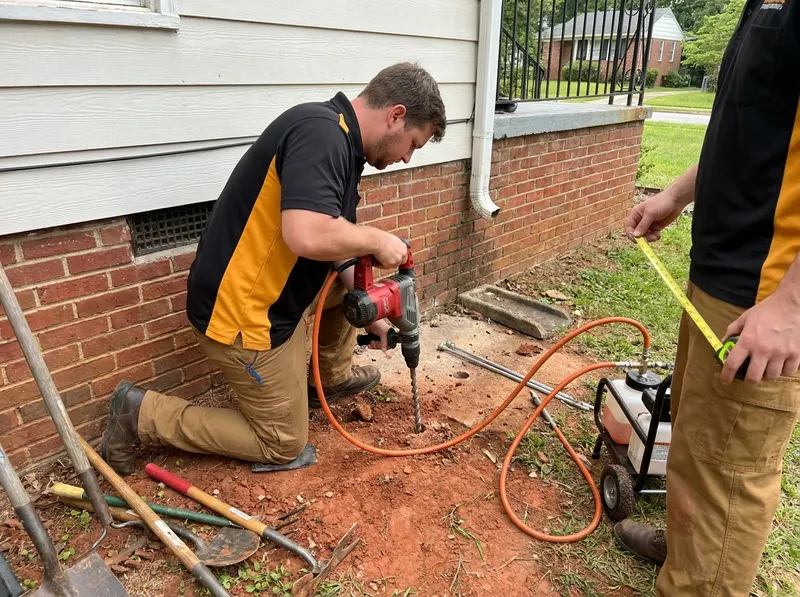
Subterranean termite control in Birmingham requires targeted subterranean chemical barriers due to the region's dense red clay soils and sustained humidity. Native colonies dwell underground, foraging through shelter tubes to consume the cellulose framing of homes from the sill plates upward. In historic hillside properties across Forest Park and Highland Park, stone foundations and porous mortar joints provide hidden transit pathways directly into load-bearing joists. Standard surface insect sprays fail entirely against these subterranean networks because they do not penetrate the soil matrix or reach the reproductive queen nested below the frost line.
Treatment execution follows two verified methodologies: continuous non-repellent liquid soil trenches or subterranean bait matrix arrays. Liquid applications require excavating a continuous 6-inch-by-6-inch trench directly against exterior stem walls, applying termiticide at a standard rate of 4 gallons per 10 linear feet per foot of depth, then backfilling the saturated soil. For crawl spaces prevalent in older neighborhoods like Avondale, Glen Iris, and Five Points South, interior pier supports and stem walls undergo rod injection to halt interior riser tubes. For slab-on-grade homes common in Crestwood North and Crestwood South, technicians perform precise vertical sub-slab drilling through garage seams and expansion joints spaced every 12 inches to saturate the hidden soil layer below.
Decision guidance hinges on construction architecture and landscape disruption limits. If a foundation is surrounded by mature hardscaping, continuous flagstone patios, or established heritage root systems, common near the Birmingham Botanical Gardens, in-ground monitoring stations spaced every 10 to 15 linear feet deliver complete colony elimination via insect growth regulators without trenching disruption. Conversely, if an active infestation is currently hollowing floor joists or door frames inside a Roebuck Springs or East Lake bungalow, an immediate non-repellent liquid perimeter provides faster structural protection by transferring lethal active agents through worker social grooming within 30 to 90 days. The operational trade-off is mechanical site disturbance versus total eradication speed.
All treatments deployed comply strictly with Alabama Department of Agriculture and Industries structural pest management regulations. Technicians arrive in marked fleet service vehicles equipped with commercial low-pressure injection rigs, calibrated flow meters, and personal protective equipment. Chemical formulations utilize non-repellent active ingredients such as fipronil, which bind tightly to Birmingham's iron-rich clay particles and prevent off-target leaching into local urban watersheds while remaining undetectable to foraging worker termites.
Every job gets a firm, written price after a free on-site visit.
Tell us about your subterranean termite control job in Birmingham and we'll send a clear, written quote, usually the same day.
 Quervia Pest Control