Food preparation environments in dining corridors like Avondale, Five Points South, and Highland Park face aggressive pest pressure fueled by grease accumulation and high humidity along the Red Mountain cut. A…
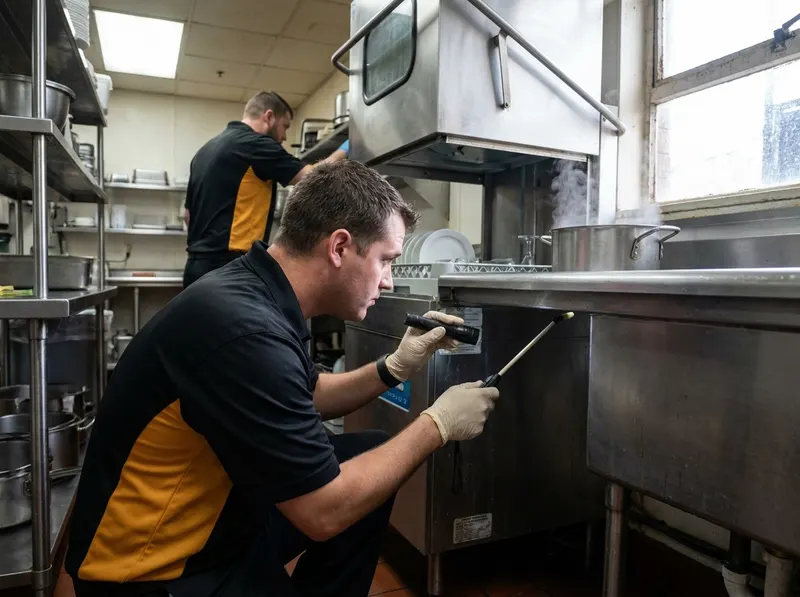
Food preparation environments in dining corridors like Avondale, Five Points South, and Highland Park face aggressive pest pressure fueled by grease accumulation and high humidity along the Red Mountain cut. A commercial kitchen pest protocol differs fundamentally from standard commercial spray routes by eliminating airborne broadcast chemicals over food prep surfaces. Instead, technicians deploy targeted insect growth regulators (IGRs) and non-repellent gel baits directly inside electrical raceways, hollow equipment legs, and compressor housings where German cockroaches nest. Structural gaps larger than 0.25 inches around utility penetrations behind dishwashers are sealed using high-temp silicone and copper mesh to stop rodent migration.
Drain lines represent the primary breeding vector for phorid and drain flies in high-volume kitchens near Sloss Furnaces and East Lake. Routine chemical pouring fails because liquid insecticides wash out within seconds and do not penetrate organic grease crusts. The protocol applies thick bio-enzymatic foam that clings to the 360-degree interior surface of floor sink drains, digesting the gelatinous organic film that flies feed upon. Kitchens in older structures throughout Forest Park, Glen Iris, and Crestwood North also encounter perimeter rodent invasions seeking moisture during wet Alabama seasons. Exterior tamper-resistant bait stations paired with interior mechanical snap traps placed along wall runways isolate rodent movement without exposing food to toxic baits.
Choosing a comprehensive technical protocol over basic perimeter spraying involves a trade-off between operational adjustment and long-term compliance. A basic exterior spray requires zero prep but fails to stop indoor reproduction cycles, leaving facilities vulnerable to health inspection point deductions. The kitchen protocol requires staff to remove bottom kick plates and clear floor debris prior to after-hours service visits, but it interrupts the reproductive cycle at the egg stage. Service documentation provides exact batch tracking and active ingredient logs, satisfying Jefferson County environmental health guidelines while maintaining zero-residue margins across meat, produce, and dishware zones.
Every job gets a firm, written price after a free on-site visit.
Tell us about your commercial kitchen pest protocol job in Birmingham and we'll send a clear, written quote, usually the same day.
 Quervia Pest Control