Crawl space moisture control directly alters the micro-climate beneath historic and mid-century foundations across Birmingham. Neighborhoods like Highland Park, Forest Park, and Glen Iris feature historic raised…
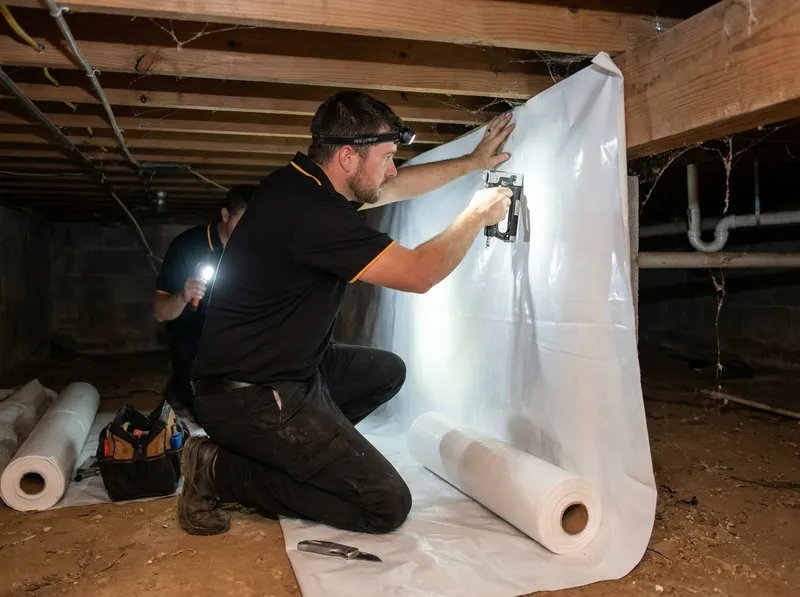
Crawl space moisture control directly alters the micro-climate beneath historic and mid-century foundations across Birmingham. Neighborhoods like Highland Park, Forest Park, and Glen Iris feature historic raised foundations built over heavy clay soils that retain water after seasonal mountain runoffs. Without a sealed vapor retarder, crawl space air reaches relative humidity levels above 70%, which raises subfloor wood moisture content past the 19% threshold required for wood-decay fungi and subterranean termite colonization. Installing a continuous 10-mil to 20-mil virgin polyethylene vapor barrier blocks ground transpiration, stabilizing subfloor wood moisture below 15% and removing the primary conditions required by dampwood pests and German roaches nesting near foundation vents.
Ground barrier installation addresses structural threats differently than perimeter chemical sprays. While a liquid termiticide provides an external soil defense, it does not correct internal fungal rot or stop subterranean termites from constructing shelter tubes up unsealed foundation piers in damp voids. A fitted vapor barrier covers 100% of exposed earth, extends a minimum of 6 inches up interior masonry piers, and secures with mastic tape to stop evaporation. For homes in low-elevation pockets of East Lake, Roebuck Springs, and Avondale, open vent ventilation often pulls in warm, humid summer air that condenses against cool floor joists; in these situations, pairing a vapor barrier with closed foundation vents and a dedicated commercial dehumidifier stops wood saturation, whereas open-vent passive barriers alone only address ground evaporation.
Selecting moisture barrier thickness depends on maintenance access needs. A basic 6-mil polyethylene barrier covers exposed soil in low-traffic storage spaces, but tears easily under foot traffic or servicing access. A heavy-duty, reinforced 12-mil or 20-mil barrier withstands repeated access from technicians servicing plumbing lines or HVAC ducts beneath Crestwood North and Crestwood South bungalows. While a basic barrier leaves foundation walls exposed, full crawl space encapsulation covers masonry perimeter walls up to within 3 inches of the sill plate, maintaining the mandatory termite inspection gap required by the Alabama Department of Agriculture and Industries while stopping lateral moisture transmission.
Every job gets a firm, written price after a free on-site visit.
Tell us about your crawl space moisture and vapor barriers job in Birmingham and we'll send a clear, written quote, usually the same day.
 Quervia Pest Control