Rodent infestations across Jefferson County stem from two primary invaders: the subterranean Norway rat (*Rattus norvegicus*) entering through stone foundation gaps and the arboreal roof rat (*Rattus rattus*) using…
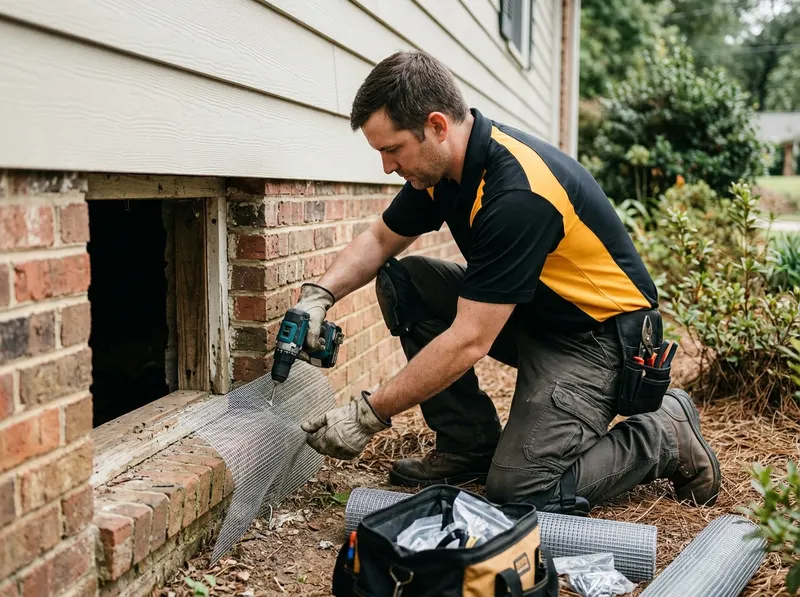
Rodent infestations across Jefferson County stem from two primary invaders: the subterranean Norway rat (*Rattus norvegicus*) entering through stone foundation gaps and the arboreal roof rat (*Rattus rattus*) using tree limbs to breach roof valleys, dormers, and soffit vents. In historic, mature-canopy Birmingham neighborhoods such as Highland Park, Forest Park, and Five Points South, roof rats traverse overhanging oak limbs to exploit rotted fascia boards. Conversely, in classic mid-century crawlspace homes common to Crestwood North, Crestwood South, Glen Iris, Avondale, and East Lake, rodents routinely gain ingress via degraded sub-floor vent covers, HVAC chase penetrations, and loose plumbing pipes near the red clay soil line.
Effective rodent abatement requires distinguishing between temporary population suppression and definitive structural exclusion. Standard broadcast rodenticides introduce secondary poisoning risks to domestic pets, fail to stop outdoor migration, and frequently result in rodents dying inside interior wall voids, producing weeks of severe decomposition odors. Structural exclusion treats the building envelope as a closed system. Technicians use copper mesh, 1/4-inch 16-gauge galvanized steel hardware cloth, and metal flashing to seal gap tolerances as small as 1/4 inch for mice and 1/2 inch for rats. Polyurethane expanding foam alone is never used as a primary barrier because rodent incisors exert 24,000 pounds per square inch of pressure, biting directly through standard foam.
Decision-fit selection depends on whether structural entry paths remain open. If an infestation occurs in a sealed home where a single mouse entered through an open utility door, targeted mechanical trapping alone resolves the issue within 5 days. If rodents access the attic continuously via the roof line near Birmingham Botanical Gardens or Vulcan Park, mechanical trapping without physical exclusion provides only temporary relief as new rodent colonies colonize the pheromone-scented pathways within weeks. The trade-off is higher upfront investment: exclusion demands higher labor costs to access steep roof peaks and tight crawlspace vents, but it halts recurring extermination fees by permanently barring access.
1. Exterior structural inspection: Technicians survey the roofline, foundation wall, crawlspace access well, and utility penetration points to map all active rodent runs, rub marks, and gnaw apertures.
2. Interior mechanical staging: Strategically mapped commercial snap traps and sensory stations are placed along observed travel paths within attics, basements, and subfloors, operating without poisonous baits inside living areas.
3. Exterior barrier installation: Technicians anchor galvanized steel hardware cloth across gable louvers, seal plumbing lines with steel wool and elastomeric compound, and secure crawlspace doors to prevent re-entry.
Every job gets a firm, written price after a free on-site visit.
Tell us about your rodent trapping and exclusion job in Birmingham and we'll send a clear, written quote, usually the same day.
 Quervia Pest Control